
Alice: The Woman Behind the Key

Updated: Aug 20

The following post contains lore from the books shown below. Proceed carefully, traveler.
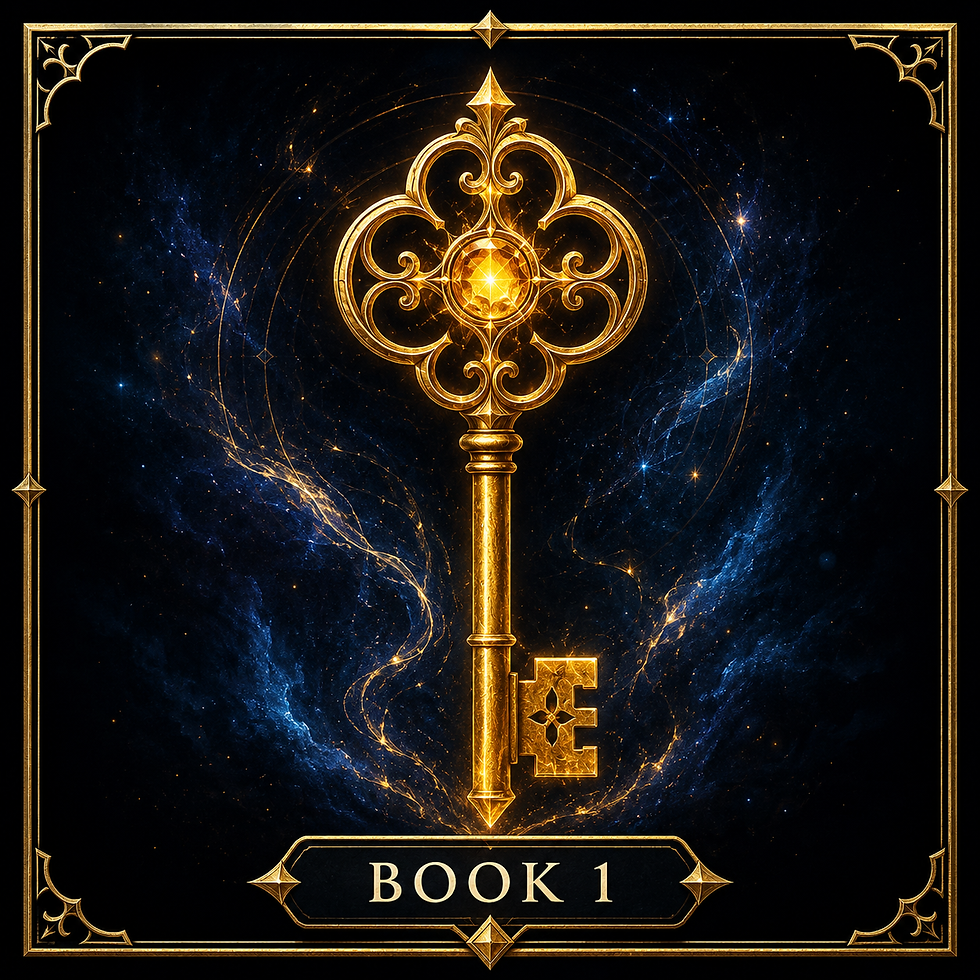


Alice was never supposed to save the multiverse.
Before the Tavern of Realms, before the Key, before forced rifts and cosmic wars, she was a barista trying to finish a closing shift, pay her bills, and get her seven-year-old son home at a reasonable hour.
Then a stranger walked into Green Bean Haven and handed her a Key, after that everything changed.
In The Key at Closing Time, Alice enters the Tavern of Realms with no training, no knowledge of magic, and absolutely no idea why she has been chosen. She is surrounded by beings who understand the multiverse better than she does, from Nerissa and Ivor to Eterna, the ancient intelligence woven into the Tavern itself.
Alice's first advantage is not magic.
It is experience.

Years of dealing with difficult customers, long shifts, financial pressure, and the exhausting reality of raising Leo on her own have taught her how to keep moving when she would rather collapse. Faced with magical disasters, argumentative dwarves, dangerous travelers, and an interdimensional tavern that seems to have its own opinions, she does what she has always done.
She adapts.
Sometimes that means studying the Keykeeper's Handbook. Sometimes it means learning to build wards or wield the Key as a blade. Sometimes it means peeling potatoes in Ivor's kitchen because being the Keykeeper apparently does not excuse anyone from helping with dinner. And sometimes it means using the same voice she once used on difficult café customers against creatures capable of leveling buildings.
That part of Alice never disappears.
Even as her responsibilities grow, she remains deeply connected to the life she had before the Tavern. She still loves DreamStruck. She still reaches for sarcasm when everything becomes too frightening. She still worries about Leo before she worries about herself.
Especially Leo.
Their relationship is at the heart of Alice's story.
When they first arrive at the Tavern, Leo is seven years old, curious enough to see wonder where Alice sees danger. As the multiverse becomes increasingly unstable, Alice's instinct is always the same: keep him safe. The problem is that Leo does not remain the little boy she brought through that first portal.
By The Collector's Hunt, three years have passed. Leo is ten, building spider-bots, studying runes, experimenting with dimensional technology, and becoming increasingly connected to forces Alice does not fully understand.
Alice has changed too. She is no longer the frightened woman clutching a glowing Key in an unfamiliar world. She has crossed unstable realms, fought beside warriors, learned to wield the Key as an Adaptive Blade, and survived a conflict that permanently changed both her and the Tavern.
But surviving something does not mean leaving it behind.
Alice enters The Collector's Hunt carrying the memory of people she could not protect and choices whose consequences still follow her. Those experiences make her stronger, but they also make her more afraid of what the multiverse might demand from Leo. That becomes one of the central tensions of her story.
Alice wants her son to grow. She wants him to become capable, curious, and independent. She just wishes independence did not involve dimensional anomalies, hostile cultists, experimental spider-bots, and ancient cosmic forces taking an interest in him.
Unfortunately, the multiverse has terrible timing.
The arrival of the Collector pushes Alice into an even more difficult kind of conflict. Unlike enemies who simply want destruction, the Collector believes he is trying to prevent something worse. He sees sacrifice as unavoidable and believes entire realms can become pieces in a larger calculation if the alternative is catastrophe.
Alice cannot accept that. Yet the farther she follows his trail across Glacidia, Aqualithe, Pyrenos, and beyond, the harder it becomes to pretend every choice has a clean answer.
That may be the greatest change in Alice.
At the beginning of her journey, she wants to know what the right thing is. Eventually, she learns that sometimes there is no perfect choice. Sometimes, there are only people depending on her to choose anyway. And those decisions leave scars.
By the later events of The Collector's Hunt, Alice has seen victories come with consequences she never imagined when she first walked through the Tavern's doors. Some people see her as a protector. Others question her decisions. Alice herself is often somewhere between the two. She does not always know whether she made the right choice.
She only knows why she made it. That is what makes her journey important to me.
Alice does not become fearless. She does not suddenly possess every answer because someone gave her a magical Key. She makes mistakes. She doubts herself. She carries guilt for people she could not save and worries constantly about what the next decision might cost. But she keeps choosing to care.
She keeps protecting people even when protecting everyone becomes impossible.
She keeps opening the doors of the Tavern to travelers who need somewhere to go.
And as ancient prophecies, forgotten conflicts, and forces far older than Alice begin pulling her toward a destiny larger than anything she wanted, she slowly learns that being the Keykeeper is not about becoming the person everyone expects her to be. It is about deciding what kind of Keykeeper she wants to become.
Alice started this story counting the minutes until the end of a café shift.
Now she stands at the center of a multiverse that may depend on her choices.
She is still a mother.
Still sarcastic.
Still tired more often than she would probably admit.
She just happens to carry the Key to reality now.
Till the next rift,
Author


Comments